
MENU



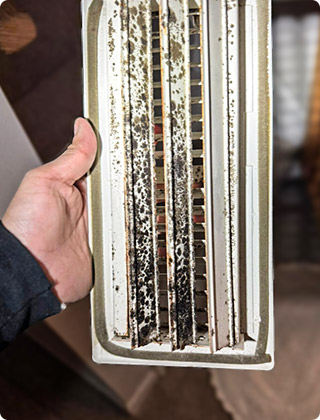
Many homeowners first notice mold in an air conditioner when there is an unfamiliar odor, dark buildup near vents, or residue around the indoor unit. That moment often raises immediate questions. Is mold in an AC unit dangerous? Is it common? And what does it actually mean when people talk about black mold in an air conditioner?
In this guide, we explain what causes mold in air conditioners and HVAC systems, how to tell normal buildup from potential problems, and when it may make sense to investigate further.
We focus on environmental conditions and building systems. We do not diagnose health conditions, confirm exposure, or predict outcomes.
Mold growth indoors depends on three basic factors: moisture, organic material, and time. Air conditioning systems can unintentionally provide all three.
An AC system cools warm air by passing it over cold coils. When warm, humid air meets those cold surfaces, condensation forms. That moisture can be collected in drip pans, ducts, filters, or insulation if drainage or airflow is limited.
When moisture persists, mold may begin to grow, feeding on dust, debris, or other organic material inside the system. This is often referred to as AC or HVAC mold.
Yes, mold in an air conditioner is relatively common, especially in humid climates or buildings with older systems. That does not automatically mean a serious problem exists.
Some levels of microbial growth can occur in many mechanical systems that handle air and moisture. What matters is the extent, location, and underlying conditions allowing growth to continue.
Black mold in the air conditioner is often misunderstood. Dark or black-colored buildup does not automatically indicate a specific mold species. Many types of molds appear dark when growing on certain surfaces. Visual appearance alone cannot confirm whether something is Stachybotrys or any other specific type. Proper identification requires laboratory analysis.
When people refer to black mold in an AC unit, they are usually describing dark growth they can see or smell, not a confirmed species.
Common indicators of black mold in air vents or AC components are often subtle. They are usually noticed during routine cleaning or seasonal system use.
These signs indicate conditions that may allow microbial growth and warrant further evaluation.
It is important to separate mold growth in an AC unit from mold growing elsewhere in the building. An HVAC system can circulate air, but it does not create mold on its own.
Mold found in ductwork or air handlers often reflects moisture issues within the system itself. Mold on walls, ceilings, or floors may point to leaks or condensation outside the HVAC system.
Symptoms such as congestion, irritation, or headaches are common and have many possible causes. They are not proof of mold presence or exposure. Environmental testing focuses on conditions within the building, not on diagnosing health effects.
When people notice patterns, such as odors coinciding with system operation, they often choose to evaluate the HVAC system as part of a broader indoor air quality assessment.
The question of whether mold in an air conditioner is dangerous does not have a single answer. Mold risk depends on multiple factors, including the type of growth, the amount present, and how long conditions have existed.
Some mold growth may be limited to small, localized areas that can be addressed through maintenance. Other situations may involve widespread moisture problems that deserve closer attention.
Guidance from organizations like the Centers for Disease Control and Prevention (CDC) and the Environmental Protection Agency (EPA) emphasizes moisture control as the key factor in managing mold, rather than focusing on mold species alone.
Recurring mold in an AC unit usually points to unresolved moisture conditions rather than ineffective cleaning.
Without addressing these factors, mold may return even after visible buildup is removed.
Professional mold testing focuses on environmental data. At O2 Mold Testing, we evaluate indoor conditions to help identify whether mold-supporting environments may exist.
| What Testing Evaluates | What Testing Does Not Do |
|---|---|
| Airborne mold indicators | Diagnose medical conditions |
| Moisture presence | Confirm health outcomes |
| Surface samples | Guarantee safety or clearance |
Testing is often used as a rule-out or clarification step when conditions are unclear.
Call us at 888-202-1680 to discuss whether mold testing makes sense for your air conditioner or HVAC system.
Preventing mold in an air conditioner focuses on managing moisture and airflow rather than eliminating mold entirely. Mold spores are common in both indoor and outdoor air, but growth inside an AC unit is more likely when moisture is allowed to persist.
The steps below are general prevention measures. They reduce risk but do not confirm that mold is absent or guarantee that growth will not occur.
Moisture control is the most important factor in reducing AC mold.
Persistent moisture inside an AC unit or HVAC system can allow mold to develop even when surfaces appear clean.
Restricted airflow can cause cold surfaces to stay damp longer than intended.
Better airflow helps surfaces dry more efficiently after condensation forms.
Insulation around ductwork and air handlers can trap moisture if it becomes damaged or compressed.
These areas are often overlooked but can contribute to recurring mold in AC systems.
Regular maintenance does not prevent all mold, but it can help identify conditions early.
Observation helps identify patterns, not diagnoses.
No prevention step guarantees that mold will not develop. Building design, climate, system age, and usage patterns all play a role.
Prevention should be viewed as risk reduction rather than proof that a system is mold-free, or that indoor air quality concerns are resolved.
Homeowners often consider evaluation when:
This does not mean a serious issue exists. It means gathering information may be helpful.
No. Dark growth does not automatically indicate a dangerous situation. Evaluation depends on conditions, extent, and moisture sources.
An HVAC system can circulate air, but mold growth depends on moisture and surfaces. Spread is not automatic or guaranteed.
Cleaning may remove visible buildup, but underlying moisture conditions determine whether mold returns.
This article does not provide operational advice. Decisions should be based on system condition and professional guidance.
We provide independent mold testing focused on environmental data, not assumptions. We help homeowners understand indoor conditions, so decisions are based on information rather than guesswork.
If you have concerns about mold in an air conditioner or mold in an HVAC system, testing may help clarify what is happening inside the space.
Contact O2 Mold Testing to learn more about our testing process or request an evaluation when appropriate.
Understanding conditions is often the first step toward informed decisions. We are here to help you gather that information responsibly.