June 2024
updated: 06/24/2026
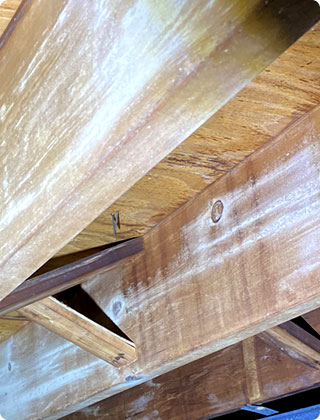
White Mold in House: Signs, Causes, and What to Do
Finding a white, fuzzy, or chalky patch in your house can be confusing. A lot of homeowners are not sure whether they are looking at mold, residue, dust, or a mineral deposit. The tricky part is that color alone does not tell the full story. What matters more is where it shows up, how it behaves, whether there is a musty smell, and whether moisture is feeding the problem.
This guide breaks down what white mold can look like, what causes it, where it tends to appear, and what steps usually make sense next.
What White Mold in a House Can Look Like
White mold is not one specific type of mold. In everyday use, people usually mean mold growth that looks white, off-white, or pale gray on a surface. Depending on the material and the moisture conditions, it may appear:
- Fuzzy or cotton-like
- Powdery or dusty
- Flat and patchy
- Stringy along wood grain or rougher surfaces
Sometimes it stays white. Other times it darkens or changes as it spreads. That is part of what makes it easy to misread. A pale patch on wood, drywall, or stored items may be mold, but it may also be something else. Our guide to black and white mold differences explains why color alone can be misleading.
Common Signs That the White Substance May Be Mold
Texture, Odor, And Where It Shows Up
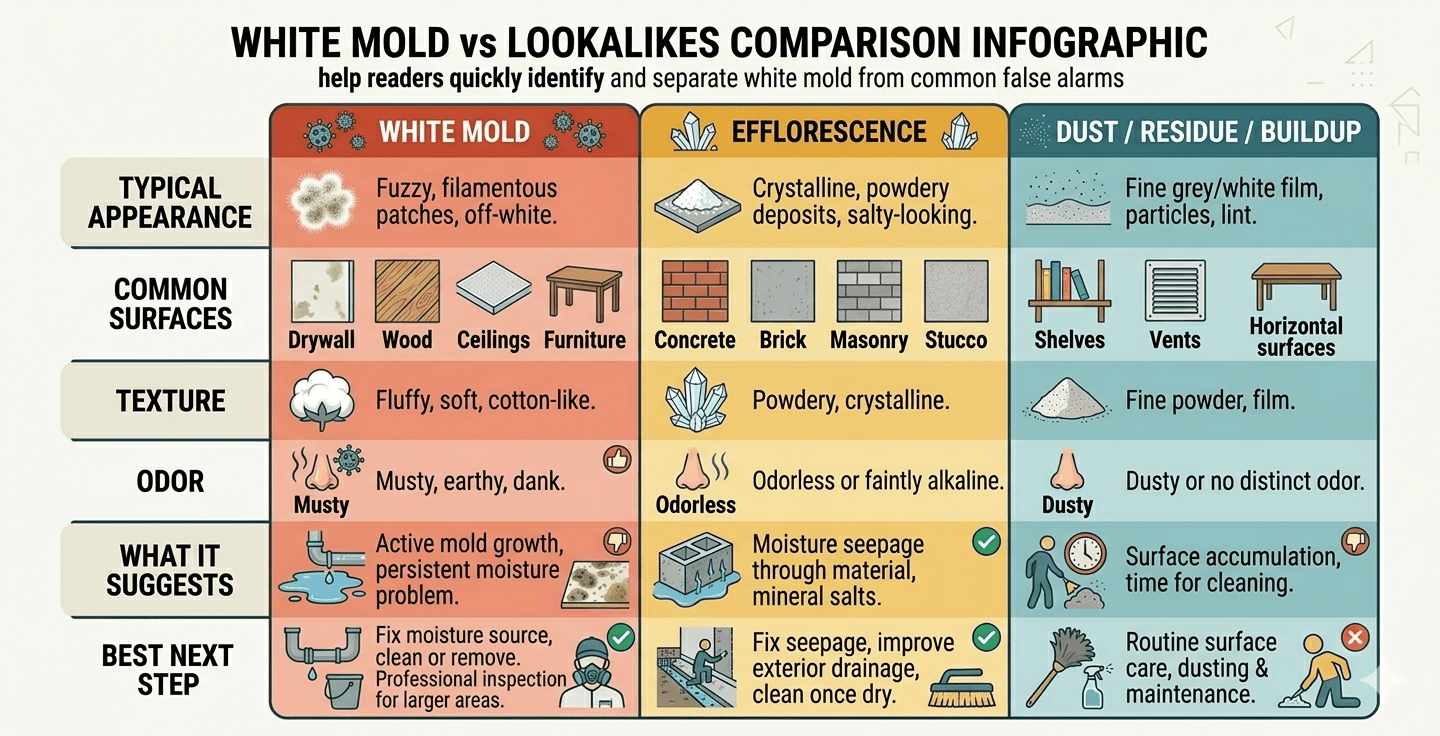
A few clues can make mold more likely. It often appears in places that stay damp, humid, or poorly ventilated. Basements, crawl spaces, attics, bathrooms, laundry areas, and spots near leaks are common examples. On some surfaces, the growth may look soft and fuzzy. On others, it may look more like a thin powder or film.
Smell can help too. A musty, earthy, or stale odor can support the possibility of mold. Still, odor is only one clue. It does not confirm exactly what the material is, and the absence of a smell does not rule mold out.
Another thing to watch for is recurrence. If the same white substance comes back after cleaning and the area still has a moisture issue, that usually points to an underlying condition that has not been solved.
What Gets Mistaken for White Mold
Efflorescence
Efflorescence is one of the most common lookalikes. It is a white, chalky mineral deposit that forms on masonry materials such as concrete, brick, or block when moisture moves through the material and leaves salts behind.
Unlike mold, efflorescence is not biological growth. It is usually drier, more powdery or crystalline, and more common on masonry than on organic materials like wood or drywall. It also does not usually come with the same musty odor people often associate with mold.
Mildew, residue, and dust buildup
White mold can also be confused with soap residue, old paint breakdown, dust buildup, or mildew-like surface growth. Bathrooms, utility rooms, and storage spaces are common places for that confusion.
That is why it helps to look at the full pattern instead of relying on color alone.
What Causes White Mold to Grow Indoors
- Ongoing moisture or humidity: Mold growth starts with moisture. It does not always take a major water event. Long-term humidity, condensation, slow leaks, wet materials, or areas that never fully dry can be enough.
- Poor ventilation and condensation: When air does not move well, moisture tends to linger. Bathrooms, laundry rooms, closets on exterior walls, attics, and window areas can all collect condensation, especially during seasonal shifts.
- Water damage and hidden damp materials: White mold can also show up after roof leaks, plumbing leaks, appliance issues, or older water damage that was never dried thoroughly. In some cases, the visible patch is only the surface sign of moisture trapped behind drywall, under flooring, or inside a wall cavity.
Where White Mold Commonly Shows Up
Basements and crawl spaces
Basements and crawl spaces often have the exact combination of mold needs: limited airflow, higher humidity, and cool, damp materials. White mold may show up on framing, subflooring, stored boxes, fabric items, and unfinished surfaces.
Attics, bathrooms, and around windows
Attics can develop mold because of roof leaks, weak ventilation, or insulation and airflow issues. Bathrooms and window areas are also common trouble spots because they deal with repeated moisture and condensation.
Wood, drywall, and stored items
White mold on wood may appear on framing, trim, shelving, furniture, or stored materials in damp areas. It can follow the grain and show up as fuzzy or uneven patches.
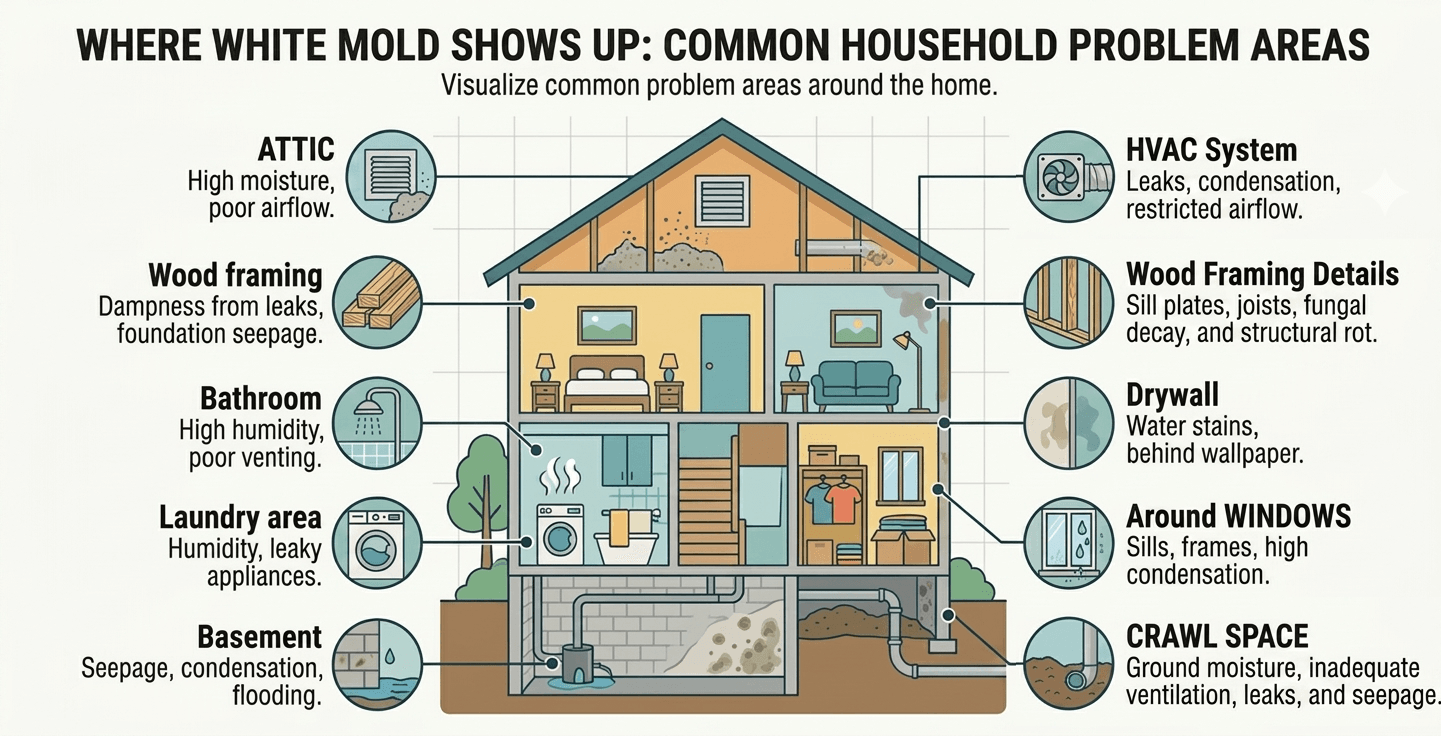
White mold on drywall can be more difficult to deal with because drywall is porous. Even when the visible growth looks minor, moisture may have moved beneath the surface. Cardboard boxes, paper goods, and fabric storage items can also develop this kind of growth in damp conditions.
What to Do if You Think You Found White Mold
- Start with moisture control: The first step is not just removing what you see. It is dealing with the moisture that allowed it to grow in the first place. That might mean improving airflow, lowering indoor humidity, drying wet materials, or dealing with a leak or condensation issue. If the moisture source stays active, the growth can return even after cleanup.
- Clean small visible growth carefully: For smaller areas on non-porous or semi-porous surfaces, careful cleaning may be possible. The goal is to remove visible growth without spreading debris through the space. Protective gear, controlled cleaning, and proper drying usually matter more than aggressive scrubbing.
- Know when the material may need to be removed: Porous materials are different. If drywall, insulation, cardboard, or other absorbent materials are affected, surface cleaning may not be enough. In some situations, removal and replacement are the more practical next step, especially if the material stayed damp or the growth keeps returning.
If you are not sure whether the white material is mold or something else, getting a clearer read on the situation can make the next decision easier.
When Mold Testing May Be Worth Considering
Mold testing is not always the first step when mold is already visible. Often, the bigger question is where the moisture is coming from, how far the condition may extend, and whether similar growth may be present in less obvious areas.
A professional assessment may help when the source is unclear, when the white substance could be confused with something else, or when better documentation would make the next step easier to choose. For homeowners who want that kind of clarity, O2 Mold Testing offers mold testing services as a focused next step rather than a one-size-fits-all answer.
Can White Mold Affect Health or Indoor Air Quality?
Questions about mold often turn into questions about health and indoor air quality. The practical approach is to stay measured. According to the EPA and CDC, mold exposure does not affect everyone the same way, and damp or moldy indoor environments may cause effects for some people while others may notice none.
What is fair to say is that indoor mold growth points to a moisture problem, and moisture-related conditions can reduce indoor environmental quality. EPA also emphasizes that the key to controlling mold is controlling moisture, which is why most homeowners are better served by identifying the material carefully, correcting the moisture issue, and deciding whether cleanup, removal, or further evaluation makes sense.
If the same issue keeps coming back or the situation still feels unclear, a more focused inspection or test can help narrow things down without turning the decision into a hard sell.
How to Help Prevent White Mold from Coming Back
Preventing white mold usually comes down to controlling moisture and staying on top of problem areas. A few steps can make a real difference:
- Fix leaks and water entry issues promptly
- Improve ventilation in damp rooms
- Use dehumidification where humidity stays high
- Dry wet materials as quickly as possible
- Avoid long-term storage of absorbent items in damp areas
- Recheck old problem spots instead of assuming they are resolved
If the same area keeps showing signs of growth, the underlying moisture issue usually needs a closer look.
If you want clearer answers before deciding what to do next, contact O2 Mold Testing to schedule a professional mold assessment. This can help you determine whether you're dealing with active mold, a lookalike material, or a moisture problem that requires closer inspection.
FAQs
What does white mold smell like?
White mold is often associated with a musty, earthy, or stale odor. Smell can be a helpful clue, but it does not confirm exactly what the substance is.
Is white mold dangerous?
A better question is whether there is active moisture and indoor mold growth that needs attention. White-colored growth should be taken seriously, but color alone does not tell you how severe the situation is.
Can I clean white mold myself?
Sometimes small amounts on certain surfaces can be cleaned carefully, but porous materials such as drywall, insulation, cardboard, and some fabrics can be harder to address fully. The right next step depends on the material and the moisture source.
Is white mold on wood a problem?
It can be. White mold on wood often points to damp conditions, limited airflow, or an unresolved leak or humidity issue. Even when the visible area looks minor, the moisture pattern still matters.
What about white mold on drywall?
Drywall is porous, so visible growth can be more concerning there than on a hard, cleanable surface. If drywall has stayed damp or the growth returns after cleaning, removal may be more practical than surface treatment.
Do I need mold testing if I can already see mold?
Not always. Visible growth often means the first priorities are moisture correction and understanding the extent of affected material.
About Author
Luther Litchfield is a mold inspection and testing specialist at O2 Mold Testing. He writes about mold testing, moisture concerns, indoor air quality, and common mold-related questions, drawing from hands-on experience with residential and commercial properties.
- Facebook
- About author