Published: 11/2026
by Luther Litchfield
Mold on or Behind Drywall: Signs, Testing, and What to Do Next
Mold behind drywall is difficult to judge from the finished side of a wall. Sometimes the warning is obvious, such as visible growth, staining, or damaged paint. Other times, the wall looks fairly normal even though a past leak or recurring moisture problem has affected materials out of sight.
That is why the best first question is not simply, "Is this mold?" Start with what the wall is telling you, what happened before the problem appeared, and what information would actually change your next decision. In some situations, inspection is enough. In others, targeted mold testing adds useful documentation before materials are disturbed.
Why Drywall Develops Mold Problems
Drywall is more than a flat painted surface. Its paper facing sits next to joint compound, trim, insulation, framing, and other materials that can hold moisture. If part of that assembly remains damp, mold can develop on the drywall paper or nearby materials.
Common causes include slow plumbing leaks, roof or window leaks, appliance overflows, condensation, wet insulation, basement water intrusion, and previous water damage that never dried completely.
The EPA recommends drying wet or damp materials within 24 to 48 hours after a leak or spill to reduce the chance of mold growth. Temperature, humidity, airflow, and how long the wall stayed wet all affect what happens next.
Signs That Point to a Moisture Problem
Hidden mold rarely announces itself with one perfect clue. More often, several small signs begin to line up.
Look for:
- Bubbling or peeling paint or wallpaper
- Soft, swollen, warped, or crumbly drywall
- Damp or distorted baseboards and trim
- Water stains that return after repainting
- A musty odor concentrated near one wall or corner
- A section that stays damp longer than surrounding materials
- A known leak, overflow, roof problem, or other water event involving that area
The pattern matters more than any single warning sign. A localized odor near a wall with a documented plumbing leak is more informative than a general musty smell across an entire basement. Neither proves hidden mold, but the first gives an inspection a clearer place to start.
What Mold on Drywall Can Look Like
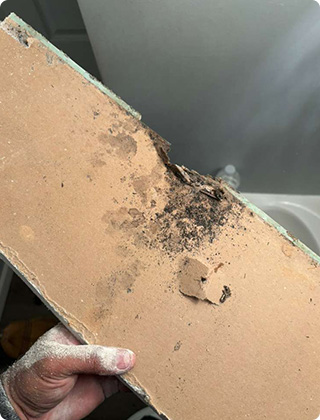
Mold on drywall can appear black, green, gray, brown, or white. It may look fuzzy, powdery, speckled, patchy, or almost like a stain. Growth can follow a seam, collect near a baseboard, appear at a ceiling line, or show up where paint has begun to bubble.
Color alone is a poor shortcut. Dark growth is often called "black mold", but appearance cannot reliably identify a mold type or show how far a moisture problem extends behind the wall.
A visible patch tells you where to look more closely. It does not tell you the full condition inside the wall assembly.
What Common Clues Can and Cannot Tell You
| Clue |
What It Can Suggest |
What It Cannot Confirm |
| Recurring stains or bubbling paint |
Ongoing or previous moisture |
Mold behind the drywall |
| Localized musty odor |
An area worth closer inspection |
Mold type, location, or extent |
| Moisture-meter reading |
Elevated moisture or a moisture pattern |
The presence of mold |
| Thermal-imaging anomaly |
A temperature pattern worth checking |
Mold or moisture by itself |
| Visible growth |
A surface that needs attention |
Mold type or hidden extent |
This distinction is important because investigative tools have different jobs. A moisture meter measures moisture. Thermal imaging shows temperature differences. Visual inspection documents what can be seen. Mold sampling provides information about the material or air that was actually sampled.
None of those tools should be treated as a stand-alone verdict about an entire wall cavity.
How a Professional Investigation Usually Starts
Opening drywall is not automatically the first move. A better investigation begins by narrowing the question.
An inspector may review the wall's moisture history, look for visible material changes, check nearby surfaces, and take moisture readings. Thermal imaging may also be useful in some situations, but it is not a mold detector and should not be treated as one.
The goal is to decide whether the evidence already points to a next step or an important question remains unanswered. That question determines whether sampling has real value.
If visible growth appeared after a documented leak, the investigation can focus on mapping the damaged area, checking adjacent materials, and recording moisture boundaries for the professionals who will handle the wall.
Now consider a wall that looks mostly normal but has a persistent localized odor, a history of intermittent moisture, and no clear explanation from the finished side. If a property owner also needs documentation before deciding whether to open the wall or plan remediation, targeted testing may be much more useful.
The walls may look similar at first glance. The decision problem is different.
When Mold Testing Helps, and When It May Not
Mold testing is most useful when the result has a specific job to do.
The EPA notes that sampling is usually unnecessary when visible mold growth is already present. If the affected material obviously needs to be addressed, the exact mold type may add little to that immediate decision.
Testing becomes more valuable when uncertainty remains. That may include:
- A persistent localized odor with no visible growth
- Suspected growth that could be staining, soot, dirt, or another lookalike
- An unclear moisture pattern that needs further investigation
- A need to document conditions for a property-related decision
- A situation where test results could influence remediation planning
- A need for more information before materials are disturbed
A simple way to judge whether testing is worth doing is to ask three questions.
What Do We Already Know?
Start with the evidence that does not require a lab result. Is there visible growth? Was there a documented leak? Is the drywall damaged? Are moisture readings elevated? Has the problem returned after repairs?
What Is Still Unclear?
The surface condition may be ambiguous, or the wall may look normal despite a persistent odor. Documentation may also be needed before a sale, rental decision, or remediation project.
What Would Change Based on the Result?
This is the question that matters most. If neither a positive nor negative result would change the next step, sampling may add little. If the result would guide documentation, remediation planning, or another property decision, testing has a clearer purpose.
That is a more useful standard than testing every suspicious wall by default.
DIY Mold Test Kits vs. Professional Mold Testing
The useful comparison is not simply DIY versus professional testing. It is whether the collection method can answer the property question.
A swab or tape lift targets material on a specific visible spot. A passive settle plate captures particles that land in the dish during the exposure period, so it cannot show where they came from or map conditions inside a wall cavity.
Professional testing can select surface, air, or other targeted samples based on the question, document exact collection locations, and send the samples to a third-party laboratory. When a decision involves opening a wall or planning remediation, that sample plan and location record are often more useful than an isolated kit result.
Before You Cut into the Drywall
If you suspect mold behind a wall, start with the water problem. Active plumbing leaks, roof leaks, exterior water entry, and recurring condensation need to be addressed by the appropriate professional.
Avoid cutting, sanding, scraping, or removing suspect drywall simply to "check behind it." Disturbing affected material can spread dust and debris, and it can erase useful evidence before the area is documented.
Before cleaning, repainting, or opening the wall:
- Photograph visible staining, growth, bubbling, and material damage.
- Note known leaks, overflows, repairs, and previous water events.
- Record where and when odors are strongest.
- Keep repair or water-damage records that may explain the timeline.
- Decide whether inspection or testing information is needed first.
Good documentation is useful when owners, tenants, contractors, or insurers need to understand the same condition.
What Mold Test Results Actually Tell You
A lab report tells you what was detected in the sample that was collected. It should not be treated as a stand-alone judgment about everything inside the wall.
For a drywall concern, results are more useful when reviewed with the inspection findings, including moisture readings, visible conditions, odors, water history, sample locations, and the original reason for testing.
That combination can support the next property decision, whether that means additional moisture investigation, remediation planning, or a targeted wall opening by the appropriate professional.
Need Help Understanding a Possible Drywall Mold Problem?
If staining, recurring moisture, a localized musty odor, or suspected mold behind drywall leaves you with an unanswered property question, O2 Mold Testing provides professional mold inspection, moisture detection, sampling, and lab-based reporting.
Call 888-202-1680 to discuss the concern and schedule the appropriate mold testing or inspection service.
FAQ
Can Air Sampling Confirm Mold Behind One Specific Wall?
No, not by itself. An air sample provides information about what was captured at the sampling location and time. It does not map mold growth inside a particular wall cavity. Results are most useful when reviewed with moisture readings, inspection findings, sample locations, and the reason the sample was collected.
Who Should Open the Drywall if the Wall Cavity Needs to Be Checked?
The appropriate remediation or building professional should handle wall opening, material removal, or remediation. Mold inspection and testing can provide information and documentation that help determine whether further investigation is warranted and where it should focus.
Can Symptoms Prove There Is Mold Behind a Wall?
No. Symptoms cannot prove that mold is present behind a wall or establish that mold caused a particular health concern. Symptoms may be a reason to investigate indoor conditions, but the property still needs to be evaluated based on its own evidence.
About Author
Luther Litchfield is a mold inspection and testing specialist at O2 Mold Testing. He writes about mold testing, moisture concerns, indoor air quality, and common mold-related questions, drawing from hands-on experience with residential and commercial properties.
- Facebook
- About author